Coffee CommuniTea form: Add your own favorite tea/coffee shop

Add your favorite tea or coffee shop to this community! I’m looking for hot spots all over the world, so please share any place you truly enjoy.

Ann at Carmel's Cafe in Phoenix, AZ

Ann at Carmel’s Cafe in Phoenix, AZ

I created the Coffee CommuniTea blog  because I deal with a lot of indie businesses and authors, and — since I love connecting people and ideas — what better place to do it than a coffee or tea shop? Besides, I wrote most of my Rhythms & Muse novel and Delfaerune Rhapsody series-in-progress in such venues.

I already covered many of my favorite hot spots on this site, but want to include your favorites, as well. I would be delighted to add your perfect little meeting place for a “cuppa.”

Simply copy my “Coffee CommuniTea” form (below) into the comments, and fill it out. Or, you can print it out, complete the form, and email it to avidean@videanunlimited.com. 

I will follow up with the owner/manager to fill out any missing details, secure photos, and post everything to this site. Cheers!

…………………………………………………………………………….

Coffee CommuniTea Blog
Contributor Form

Contributor: (your name, city, state, and other contact info you wish to make available, even a mug shot – pun intended)

Today’s Cup o’ Tea (name of shop, its city/state location, its Web site and/or best online site, with its owners’ names and contact emails)

Perks (what I really like!)

Share a Cuppa (the stories about the owner, building, history, name)

What’s Brewing (coffee, tea, food)

Percolation Factor (the activity/environment/energy/service)

The Grind (what I would change)

The Grounds (location)

Tea Times (hours)

Yelp rating: ____ stars from ___ reviews

………..

Write on!
Ann Narcisian VideanBook Shepherd
Write • Edit • Publish

P.S. Learn more about my novels on my Amazon Author Central page.

Find me elsewhere online.

Brilliant idea to turn subway turnstiles into music

NYC deserves as much beauty underground as it does topside, don't you think? Photo: ©2008 ANVidean

NYC deserves as much beauty underground as it does topside, don’t you think?
Photo: ©2008 ANVidean

Leave it to a musician to think of a way to make the New York subways more beautiful! Musician James Murphy suggests, in this video, how the city might replace the unpleasant turnstile notes that benefit sightless folk, with harmonic tones to please everyone. Tuned notes would chime as people pass through the turnstiles, making music instead of mismatched sounds. He also suggests a way that won’t cost the city additional monies.

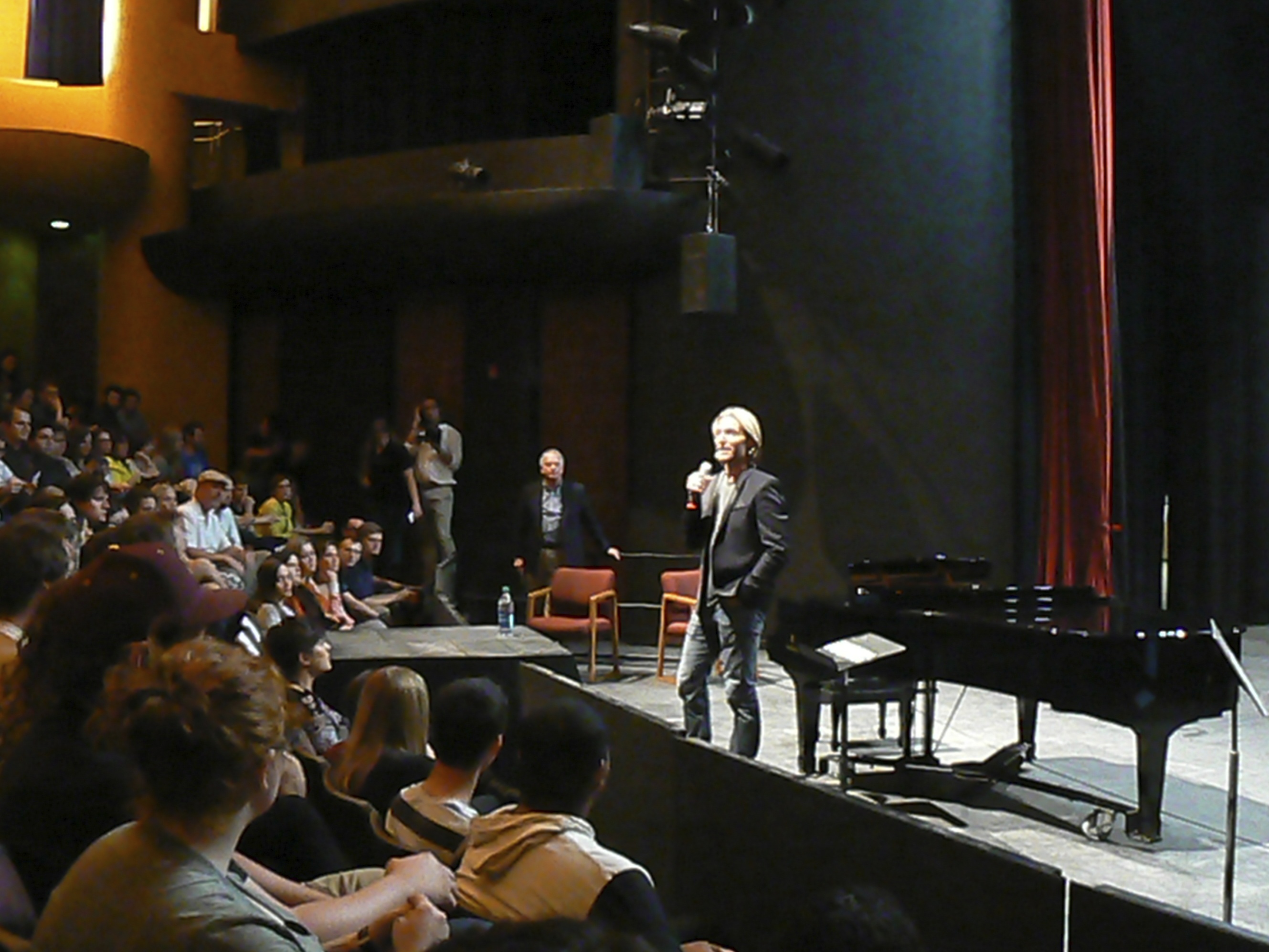
Eric Whitacre answers audience questions at ASU, Oct. 24.  Photo: ©ANVidean 2013

Eric Whitacre answers audience questions at ASU, Oct. 24.
Photo: ©ANVidean 2013

Did I mention “brilliant?”

Thank you, composer Eric Whitacre for yet another wonderful share. You always demonstrate such exceptional ideas on how music can benefit our lives!

Sleep to dream… Listen to my son’s dreams.

Five-song demo release, week of Feb. 10–15. © 2014 Cutter Videan

Five-song demo release, week of Feb. 10–15.
© 2014 Cutter Videan

I like to support young creatives, especially when it involves music… and, even more so, when it’s my son’s compositions.

Check out Cutter Videan’s five-song demo releasing this week, one song per day, on tumblr and bandcamp.

The first 200 downloads are free!

Top Design Resources to Create Compelling Books

#14 Writing Tip:  Top design resources to create compelling books—Step 2 Interior page layout

Interior page layout of Rhythms & Muse. ©2014 ANVidean

Interior page layout of Rhythms & Muse.
©2014 ANVidean

So, you completed writing your manuscript, and created a cover design with images to compel readers to pick up your book. The next step involves the production of its interior page layout.

You may think of this as a slam-dunk exercise, but it can require quite a bit of knowledge about word-processing or design programs. It takes into consideration the size of the book pages, width of margins, size of fonts, page number location, graphic images, and more. Making all these elements work well together requires quite a bit of skill with specific software programs.

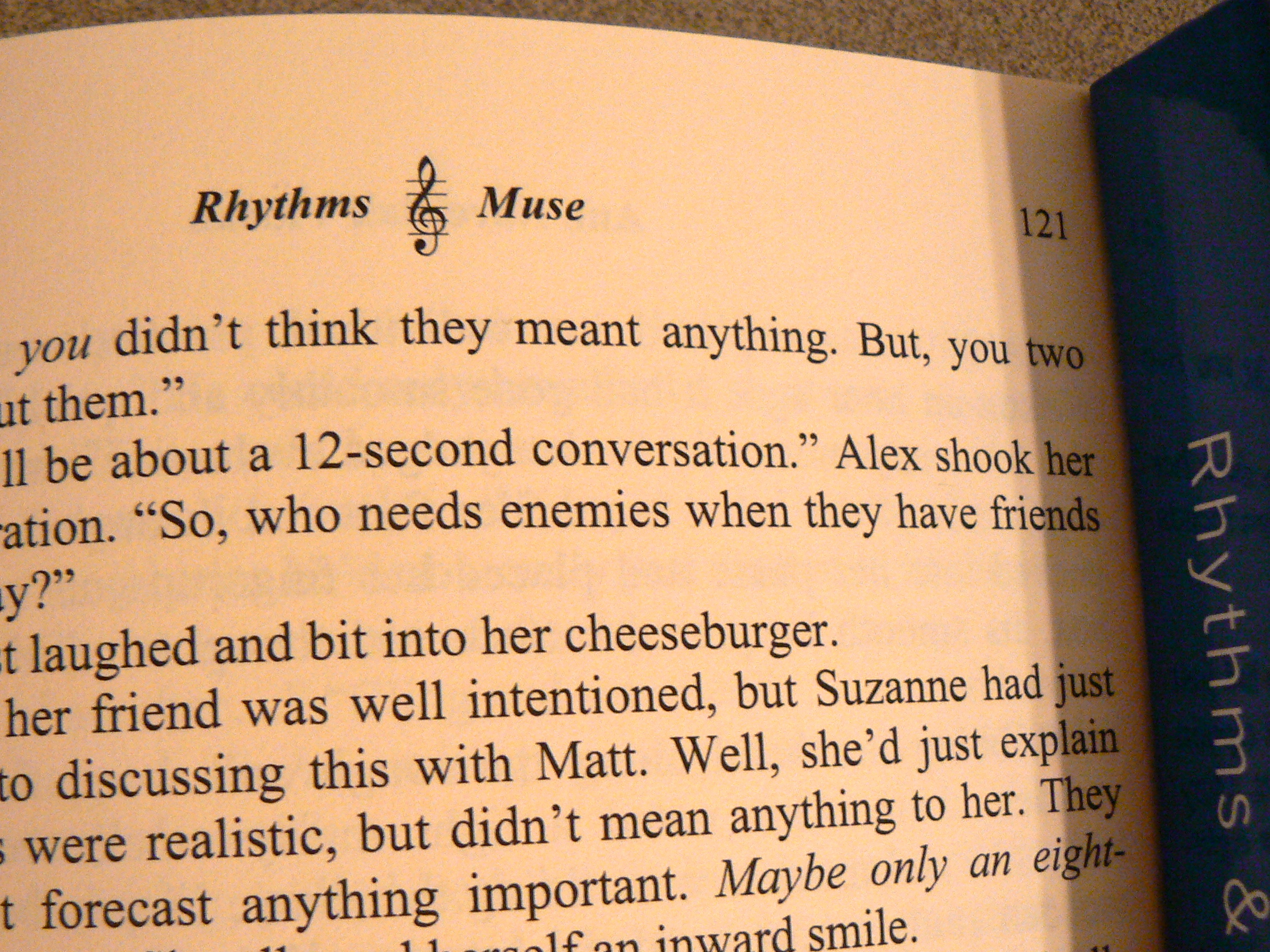
Attention to detail can make a book more compelling. Like using a treble clef ampersand to tie in my book's music theme.  ©2014 ANVidean

Attention to detail can make a book more compelling. Like using a treble clef ampersand to tie in my book’s music theme.
©2014 ANVidean

I suggest hiring a knowledgeable designer to handle interior layout for you. Higher-cost options may involve independent designers or services provided by vanity presses and print-on-demand companies. Low-cost alternatives range from independent formatting and production experts, to do-it-yourself software such as:

  • Word processors like Microsoft Word, and Scrivener
  • Layout programs like Adobe InDesign and Quark Express
  • Hybrid software like Microsoft Publisher and Apple Pages

A very helpful entry at The Book Designer blog describes all these options in-depth.

You’re welcome to contact me to discuss what tools and resources worked for me, and what I recommend to clients.

P.S. Do you have a secret to share about managing a book’s interior page layout ? Feel free to comment below.

…………………..

Write on!
Ann Narcisian Videan
Write • Edit • Self-publish • Word-of-mouth
avidean@videanunlimited.com

Authors, understand the legality behind your books, ALWAYS

TOPIC:
Do you know the legal ins and outs regarding your book? Let’s get together with Megan D. Scott with The Kleinman Law Firm, to learn more about keeping our content legal and protecting our work.

Josh Groban, Phoenix 2013

In your book, can you use photos of celebrities like the one my daughter took at the Josh Groban concert?
Can you even use their names? Can you use music lyrics and quotes?
Should you officially copyright your writing?
Find out by attending the Dec. 12 ALWAYS writers gathering in Tempe, AZ.

[In case you’re wondering, Josh is the guy in the shadows just to the right of the violinist
and behind the guy with his knee up.]
Photo: 2013 CEVidean

Next gathering:
Thursday, Dec. 12, 2013
11:30 a.m.–1 p.m.
(ALWAYS meets on the second Thursday of each month.)

Where:
DAVE & BUSTERS
(private board room)
Tempe Marketplace
2000 E Rio Salado Pkwy
Tempe , AZ – 85281
480-281-8456

back-up location:
Tea Infusion
2000 E Rio Salado Pkwy # 1064
Tempe, AZ 85281-4927
(480) 967-1141

Cost:
A writing tip, and your own lunch.

RSVP:
PLEASE show the consideration of reserving your spot at the table by:
• RSVPing through the “Join” link on our Facebook Event page
or
• Contacting Ann Videan, avidean@videanunlimited.com

If you’ve RSVP’d, please SHOW UP. If you run into a conflict, please let me know BEFORE the event so I can make the necessary adjustments for the group meeting. Cheers!
…………………………………………………………….

ABOUT ALWAYS

• Need contacts to help your writing?
• Want advice about your writing?
• Like to hang with other cool writers?

If so, our tribe – the Alliance for Literary Writers, Authors & Yabbering Scribes (ALWAYS) – is the place for you. We’re an informal group of established writers looking for camaraderie, ideas, enlightenment and connection with writers, especially in the Phoenix metro area, to talk about our craft and businesses.

Any established writer can connect with us online through our ALWAYS Facebook page, get listed in our directory of writers on our ALWAYS LinkedIn page, or you can meet with us in person at a lunch meeting. We’d love to have any experienced writer join us at our next meeting … anyone who spends a significant part of his/her week writing, and wants to rub elbows with other writers.

Follow established authors’ tips to earn visibility online

ALWAYS authors:
Using Goodreads and other online resources

Do your social media work now. Find your book later in a library like UC San Diego's Geisel Library. This crazy cool facility in La Jolla, CA -- named in honor of long-time La Jolla residents Audrey and Theodor Seuss Geisel (better known as Dr. Seuss) -- houses more than 3.5 million books! Photo: 2013 CEVIdean

Do your social media work now. Find your book later in a library like UC San Diego’s Geisel Library. This crazy cool facility in La Jolla, CA — named in honor of long-time La Jolla residents Audrey and Theodor Seuss Geisel (better known as Dr. Seuss) — houses more than 3.5 million books!
Photo of Ann: 2013 CEVIdean

Topic for our gathering:

What is your favorite online tool for authors? Goodreads? Facebook? Pinterest? Blogs? Let’s get together and share what we know about making the best use of our time online for our books.

Next gathering:
THURSDAY, Nov. 14, 2013
11:30 a.m.–1 p.m.
(ALWAYS meets on the second Thursday of each month.)

Where:
DAVE & BUSTERS
(private room)
Tempe Marketplace
2000 E Rio Salado Pkwy
Tempe , AZ – 85281
480-281-8456

Back-up location:
Tea Infusion
2000 E Rio Salado Pkwy # 1064
Tempe, AZ 85281-4927
(480) 967-1141

Cost:
A writing tip, and your own lunch.

RSVP:
PLEASE show the consideration of reserving your spot at the table by:
• RSVPing through the “Join” link on our Facebook Event page
or
• Contacting Ann Videan, avidean@videanunlimited.com

If you’ve RSVP’d, please SHOW UP. If you run into a conflict, please let me know BEFORE the event so I can make the necessary adjustments for the group meeting. Cheers!
…………………………………………………………….

ABOUT ALWAYS
• Need contacts to help your writing?
• Want advice about your writing?
• Like to hang with other cool writers?
The Alliance for Literary Writers, Authors & Yabbering Scribes (ALWAYS) is an informal group of established fiction and nonfiction writers in the Phoenix area who want to support each other’s work, share ideas and best practices, and just discuss writing topics. I’ve led this group since 2006.
Any established writer can connect with us online through our ALWAYS Facebook page, get listed in our directory of writers on our ALWAYS LinkedIn page, or you can meet with us in person at a lunch meeting. We’d love to have any experienced writer join us at our next meeting … anyone who spends a significant part of his/her week writing, and wants to rub elbows with other writers.

Seven words to encapsulate Eric Whitacre’s HIGHDEF music

Eric Whitacre answers audience questions at ASU, Oct. 24.  Photo: ©ANVidean 2013

Composer Eric Whitacre held an informal Q&A at Arizona State University, Oct. 24.   Photo: ©2013 ANVidean

My daughter Codi and I witnessed the brilliance of composer Eric Whitacre last night at Arizona State University. In Phoenix for a corporate speaking engagement, the fact that he offered to do a free, informal choral workshop and Q&A with the students and community, speaks volumes about this man’s quality.

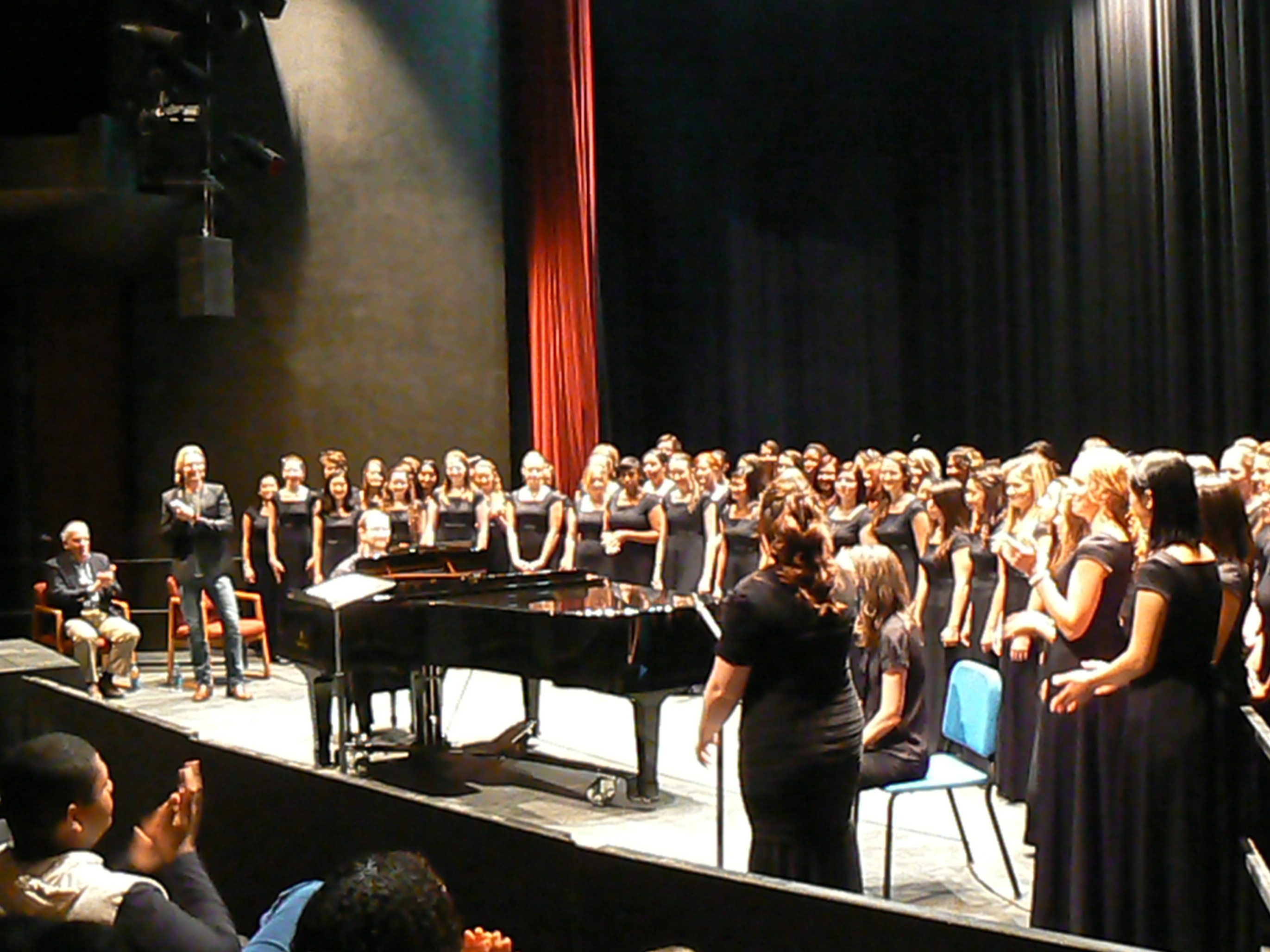
Whitacre entered the Evelyn Smith Music Theatre to a standing ovation, and briefly critiqued one of his early compositions, “She Weeps Over Rahoon.“ The ASU Women’s Chorus performed the piece, under the direction of Ashley Conway, an ASU student earning her doctor of musical arts in music (conducting).

ASU Women's Choir workshop with Whitacre. Photo: ©ANVidean 2013

ASU Women’s Choir workshop with Whitacre.
Photo: ©2013 ANVidean

Participation in the charming, inspirational hour following the critique—as Whitacre answered audience questions—solidified my perception of this man as one of the musical geniuses of our time. Whitacre filled the room with humility, a huge sense of humor, and an indomitable talent.

I could share so much, but to avoid gushing even more, I narrowed my comments to fit into seven aspects of Eric Whitacre’s music using the applicable seven-letter acronym: HIGHDEF.

Heartfelt

Whitacre’s work comes from a deep place of feeling, rather than a development of the craft. He said, at the urging of a Julliard professor, he tried to create music by learning the craft of music, but never could. He must follow inspiration gained from his feelings—sometimes delving him deep into the trenches of emotion—to bring forth the desired result.

Inspired

Poetry serves as a grand inspiration for his work. He originally wrote one of his popular

pieces, “Sleep,” to accompany the words of a Robert Frost poem, “Stopping by Woods on a Snowy Evening.” When he couldn’t get the poem’s rights, he asked his lyricist Charles Anthony Silvestri to help create new text to match the original poem’s exact cadence. You can hear the stunning result for yourself.

Whitacre described music as the gold gilt emphasizing certain poignant aspects of a poem —much like scribes, long ago, used gold highlights on passages in hand-copied books. He also described certain poems as vibrating so much with their own meaning, no music could possibly enhance them.

The composer also explained how he tried teaching, and other music jobs, but eventually recognized composition as the only job he felt inspired to really do well. He paid his dues: quit his job, immersed himself in writing music, and took every commission offered. The persistence paid off.

Groundbreaking

Most people know Whitacre because of his virtual choirs, which grew from an experiment into a cultural phenom. Thousands of people audition via video, and he compiles the recordings into a “virtual” composition using the submitted videos with added animation. The most recent, “Fly To Paradise,” released three months ago, involved 8,409 videos, and 5,905 singers in 101 countries. Whitacre’s next virtual choir, not yet announced, will involve middle-school-age youngsters.

His ideal work right now, he said, would involve working on collaborations with the likes of Radiohead, Byork, Peter Gabriel, movie score composer Thomas Newman, and others. Yessss!

He shared genuine answers to all audience questions, including how he met his wife, and his spiritual beliefs. Photo: ©2013 ANVidean

Whitacre shared genuine answers to all audience questions, including how he met his wife, and his spiritual beliefs. Photo: ©2013 ANVidean

Humanistic

A self-proclaimed agnostic, the composer said his music stems, rather than from divine inspiration, from the inspiration of humanity: love, anger, joy, children, and everything encompassing “human.”

Distinctive

The man is known for dissonance in his work, and also silence. One point he made in the workshop portion of the event, so impressed me. He talked to the singers about how to keep the music spinning through the musical rests. The choir responded to this abstract idea beautifully, and the audience could tangibly hear the “music” in the silence. Truly moving.

Emotional

Most listeners cannot help but experience strong reactions inspired by Whitacre’s work. In my opinion, its intensity originates in the man’s personality. I can’t imagine meeting anyone with a more generous spirit, genuine spark for creativity, love for humanity, and non-stop sense of humor.

Fastidious

In his short workshop last night, he focused on specific and minute details, including the manner of directing, embodying the emotion behind the words and music, and even how using varying lengths when enunciating the letter “f” lend disparate emotions. The “before and after” flow and sound of his composition changed the piece completely, allowing the audience to hear Whitacre’s brilliant emotional intention.

I recommend, given any opportunity, make the effort to attend a talk or performance by Eric Whitacre. HIGHDEFinition quality indeed.
Create a book readers want to read, through design

#13 Writing Tip: Create a book readers want to read, through design—Step 1

You walk through a book store. Shelf upon shelf of books surround you. Something on a cover makes you stop and pick up a volume.
Or…
You search online for a book to read. You click through to a genre you like and scroll down the listings. Something catches your eye, and you click to learn more.

What made you stop and look? The book cover design, of course. So, would your book meet the reader-catching test? The next few blogs entries will deal with this topic, starting today with cover design.

I created my own back cover for Rhythms & Muse using Photoshop and a photo editing software.

I created my own back cover for Rhythms & Muse using Photoshop and a photo editing software.

For my front cover, I did my research and asked contest-site designers for a specific look including certain elements. I chose this one from among more than 25 designs.

For Rhythms & Muse, I did my research and asked contest-site designers for a specific look with certain elements. I chose this one from among 25+ front-cover designs.

Book cover art involves both art and science. Not all designers—let alone authors—know the secrets to what draws a buyer’s attention. If you want an enticing design, you must do your research, considering:

  • Image elements
  • Mood
  • Color
  • Impact of photos vs. illustration
  • Font choice
  • Composition
  • Much more

Are you clear on these areas, and how your choices can influence your book design’s success? If not, you need to hire a designer. Now, I’m not saying you have to pay the big bucks for a graphic designer who specializes in book design, although that may just be the ideal solution. Today’s accessible information and technology provide a number of options:

  • Hire a professional book designer ($$$)
  • Pay for support services from print-on-demand publisher, like CreateSpace ($$)
  • Research book design online, learn the ins-and-outs, and ask for on-spec designs from a contest site like ($)
  • Research online, learn the ins-and-outs, and do it yourself using design software like Adobe Illustrator, Photoshop, or even Word, although the latter has limitations (minimal cost)

Your first step for eye-catching book design involves choosing one of the above options.

If you would like additional resources, tried and true, per my own experience, please contact me.

P.S. Can you recommend an additional resource for other writers? Do you have a book design secret to share? Feel free to comment below.

…………………..

Write on!
Ann Narcisian Videan
Write • Edit • Self-publish • Word-of-mouth
avidean@videanunlimited.com

Six Key Steps to Produce a Book

Writing Tip #12:
Six key steps to jump-start the production of your self-published book
(updated 6/4/2025)

Image

Don’t wait until the 11th hour to take care of book production details!
Photo: iStockphoto.com

So, you wrote your book, a professional edited it, and you’re ready to start the self-publishing process. But where do you start? What should you include? How do you cover yourself legally?

I self-published my first book Rhythms & Muse through CreateSpace (an Amazon company), but it took me years of research—online searches; conference attendance; and asking questions of other writers, editors and book consultants—to narrow down everything needed to actually get the book into printed form. I’m sharing my research here to make it easier for you, so you don’t have to spend all that time. I wish someone had done it for me, so I’m paying it forward.

To jump-start you, follow these six critical steps in the publishing process, and use the resources I provide as a starting point:

  1. Choose a virtual author’s assistant, if you want help
  2. Obtain an ISBN number
  3. Obtain a bar code
  4. Obtain a Library of Congress card number
  5. Find out if your content is legal
  6. Decide if you want to copyright your work

1. Decide if you want support from a virtual author’s assistant so you don’t have to do everything yourself.

This is someone who will do the legwork for the following few steps, and more. From my experience, you should expect to pay at least $65/hour for the services of a VAA. Because my novel included so much research on song permissions and royalties for lyrics, my quote from a VAA amounted to about $3,500 in 2011. Standard novels without much legal research would probably cost much less.

A great resource to learn more about this: Jan B. King’s VAA Web site.

2. Obtain an International Standard Book Number (ISBN).*

The Bowker company sells ISBNs. A unique ISBN is required for each book format you use (hardcover, softcover, e-book, audio book, etc.)  One costs about $125. You may also buy blocks of 10 numbers for $295, a great value if you’re planning to produce your book in more than one format.*

3. Obtain a bar code.*

Bar codes are required, and are produced along with the ISBN number you purchase from Bowker. This small image encrypts the cost (which you’ll need to provide), ISBN, and other information about each individual book. Bowker will provide both an ISBN-10 and an ISBN-13 number. (An ISBN-13 is based on the ISBN-10, but with the prefix 978.)

* Note: Steps 2 and 3 are available for free when publishing through KDP/Amazon, and some other print-on-demand publishers. I know many authors who happily use KDP, which enables do-it-yourself production and print-on-demand (POD) for books, CDs, DVDs, MP3 files, video, and more). Plus, they offer a very affordable broad distribution system.]

Free ISBNs are owned by the POD outlet so I recommend you buy your own for each version of a book you produce (ebook, paperback, hardback, KDP, IngramSpark, local printer, etc.)

4. Obtain a Library of Congress Control Number (LCCN).

This is a unique number assigned to each Library of Congress catalog record (book). You need only acquire an LCCN if you want your book available in libraries. LCCNs are free, but you must open an account and apply for one, which takes about two weeks. For more details, visit the LCCN sign-in page.

5. Obtain legal permissions, and licenses (for which you’ll pay royalties).

If you plan to use others’ works in your book—like quotes, lyrics, excerpts, and such—you must do three things to avoid legal issues:

  1. Identify if something is currently in the public domain
  2. Ask permission
  3. Pay the creator

I highly recommend talking with a copyright lawyer like Kevin Keener at Keener McPhail, LLC to make sure you’re in the clear using someone else’s words, images or other creative works.

6. Decide if you want to officially copyright your work.

This is optional, as anything you create is technically your copyrighted material already. But, if you’re paranoid about ownership, you can officially copyright the work through the U.S. Copyright Office. This costs $65 for a literary work.

These six steps serve as a good starting points. For my next blog entry, I plan to blog talk about design options for book production.

In the meantime, any other tips you’d care to share with other authors about the production of their books?

…………………..

Write on!
Ann Narcisian Videan
Write • Edit • Self-publish • Word-of-mouth
avidean@videanunlimited.com

Music connects leaders to success

I just ran across a New York Times Sunday Review article asking, “Is Music the Key to Success?” It inspired me in this time of decline in music education in the United States.

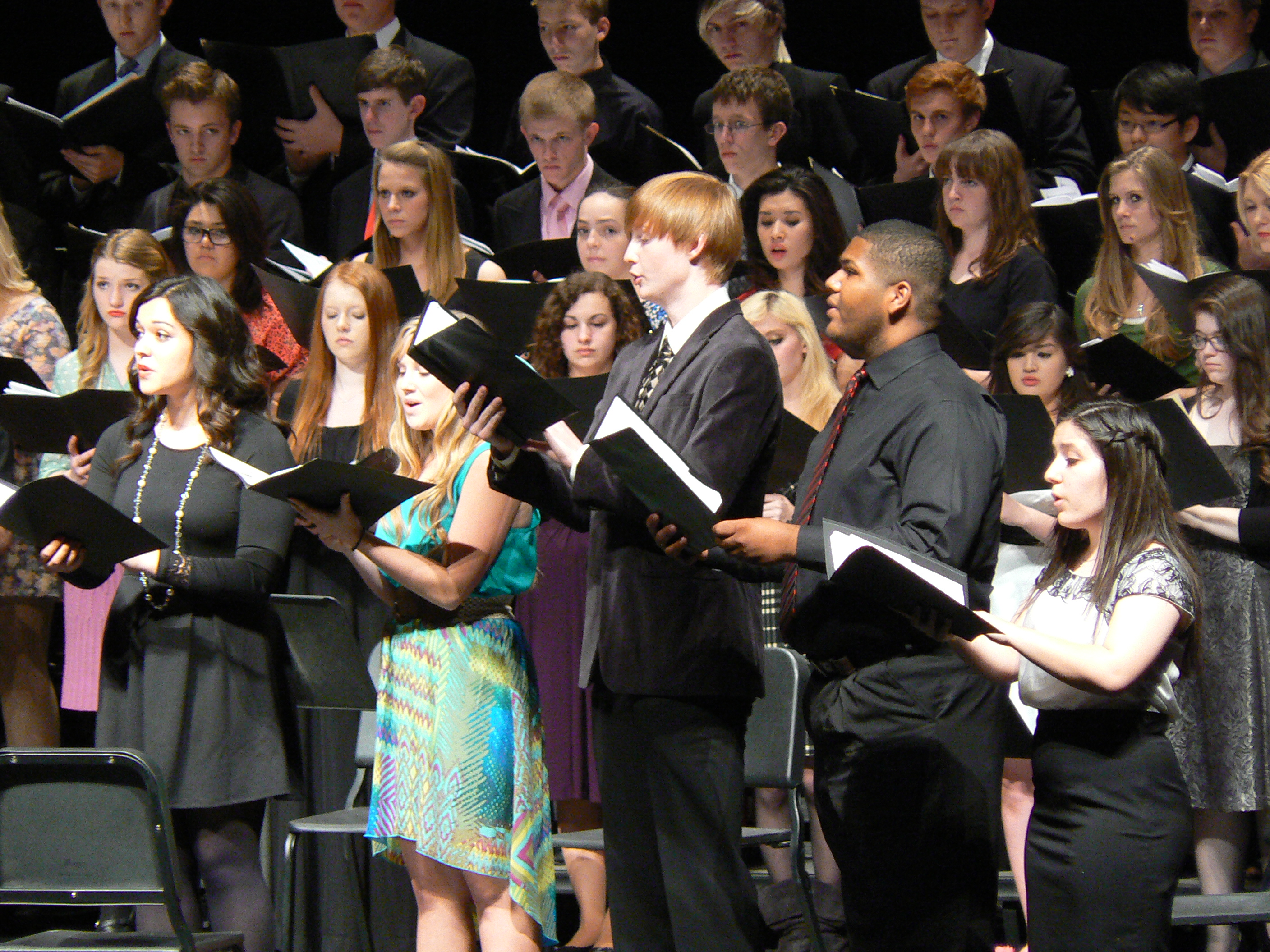
My daughter Codi singing in the Arizona Regional choir last year. Photo: ©2013 ANVidean

My daughter Codi singing in the Arizona Regional choir last year. Can’t wait to see how she succeeds. 🙂  Photo: ©2013 ANVidean

The Oct. 12, 2013, article by Joanne Lipman, interviewed a number of highly successful people, who all made a connection between their music training and their professional achievements beyond the math-music association.

Like whom? How about:

  • Paul Allen (billionaire co-founder of Microsoft), guitar
  • Woody Allen, clarinet
  • Alan Greenspan (former Federal Reserve chairman), clarinet and saxophone
  • Bruce Kovner (hedge fund billionaire), piano
  • Andrea Mitchell (NBC), violinist
  • Larry Page, (co-founder of Google), saxophone
  • Condoleeza Rice, piano
  • Chuck Todd  (NBC chief White House correspondent), French horn
  • Paula Zahn, cello

“Many high achievers told me music opened up the pathways to creative thinking. And their experiences suggest that music training sharpens other qualities: Collaboration. The ability to listen. A way of thinking that weaves together disparate ideas. The power to focus on the present and the future simultaneously,” the article said.

The article included a funny quote or two from Woody Allen, and some very cool connections between music and real life. If is definitely worth a read.

What other information have you run across that proves the importance of music in our country’s educational programs?

……………..

Play on!
Ann Narcisian Videan
Write • Edit • Self-publish • Word-of-mouth