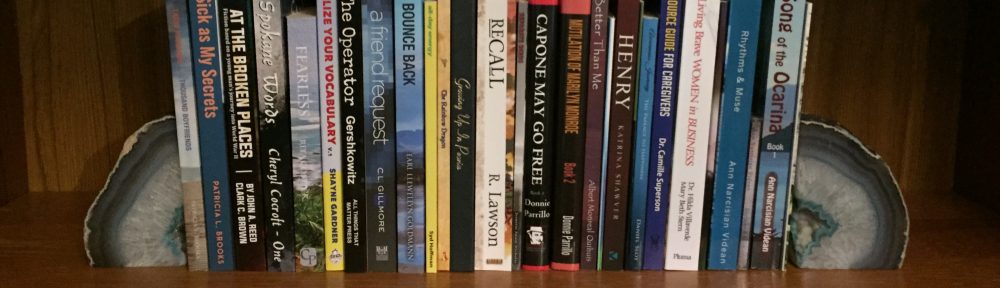
#6 Writing Tip: Authors and readers profit from free book downloads

Authors and e-book readers, do you use Kindle Select (KS) and the Kindle Owners’ Lending Library (KOLL)?

“Why would I,” you ask?

Two compelling reasons.

  • Readers receive free e-book borrows.
  • Authors gain enhanced visibility and potential sales.

Here’s how it works:

Readers, if you are an Amazon Prime member you can borrow from a collection of more than 180,000 books in the KOLL. Besides my own novel, Rhythms & Muse [big cheesy grin], the library includes 100-plus current and former New York Times best sellers — to read for free — as frequently as a book a month, with no due dates.

Watch this price drop to zero tomorrow for Amazon Prime members who want to borrow my book.

Watch this price drop to zero this weekend for Amazon Prime members who want to borrow my book.

Authors, simply give exclusive rights to Kindle for 90 days, enroll your titles, and promote free downloads to gain visibility. The best part, though, is you actually earn a share of the multimillion-dollar KDP Select Global Fund every time your book is borrowed from the KOLL on Amazon.

I’ve had several authors tell me their books get borrowed thousands of times over a couple of days through this program, and they can sell one book for every three borrowed. In the first Valentine’s Day 2012 promo I did the last weekend of January 2013, 994 readers downloaded Rhythms & Muse. [I’ll report later what happens, sales-wise.] Looks like we have everything to gain here, especially happy readers.

Authors… Readers… What are you waiting for?

If you have had an exceptional experience using KS or KOLL, the rest of us would like to hear about it in the comments below.

………………………….

P.S. Readers, in the spirit of letting you take advantage of this truly cool offering right away, I’ve scheduled my own KS promos. [Put this in the realm of “well-how-the-heck-will-you-know-about-it-if-I-don’t-tell-you” shameless promotion.] Yep, you can borrow my women’s fiction e-book this weekend — Fri., Feb. 1 through Sun., Feb. 3, 2013 — by searching for Rhythms & Muse at the KOLL.

Rhythms & Muse synopsis:

Alex, a Grammy-winning vocalist, lives the glamorous lifestyle, but hates it. Her dreams guide her life, but she doesn’t listen until one actually manifests. Will intuition, flashbacks to her 1970s high-school days in Coeur d’Alene, Idaho, and an ambitious current-day plan to reconnect with her former music partner and muse, help her find fulfillment?

Amazon review:

“Ann…has a gift for setting the scene and characters so that you feel like you have visited these places, and know these people in her book. I particularly liked the shift back and forth in time during the book — it reminds us that whichever paths we take in our lives, we are still the same person within. This book brought back memories of high school.”

#4 Writing Tip: Captivate with Storytelling Content

Can you tell where I conducted this signing for my first, published fictional story? First one to comment below, gets a $10 gift card from this hot spot.

How can you truly captivate the readers of your blog, presentation, or book? With so many rampant messages vying for everyone’s attention at every turn, you need proven techniques to blast your message through—like storytelling.

One of the best ways involves content rife with storytelling. Content must tell something interesting, real and relatable. Even in business, stories serve to attach a customer to you emotionally. Simply, they hit home.

As a novelist, and avid movie fan, I adore stories. They’ve been a part of my life since I was a small child, starting when my Mom read the magical book The Secret Garden and chilling North To Freedom to my brothers and me. I became a constant reader in high school, especially of historical romances like Jane Eyre, Pride and Prejudice, and…well…anything written by Jane Austin. As I grew older and started appreciating movies with amazing special effects like Star Wars, sci-fi and fantasy became my favorite genre(s). Those continue as my favorites today. Yes, I am a total LOTR and Harry Potter fan girl, and I stand proud.

I self-published my first novel in 2011 and, although it wasn’t written to fit my favorite genre, Rhythms & Muse culminated a life dream for me—along with its soundtrack of five original songs I wrote and performed. Today, I am full-force into writing a young-adult fantasy adventure: the Delfaerune Rhapsody trilogy. This focus on stories and writing led me to my current career in which I help authors and visionary entrepreneurs share their messages through relatable stories, available technology, and creative word of mouth marketing.

So, see what I did there? You’ll note my own tale included the six basic elements in a story:

  1. Introduction: “As a novelist…adore stories.”
  2. Initiating incident: “They’ve been a part…to my brothers and me.”
  3. Rising action: “I became an avid reader…and proud of it.”
  4. Climax: “I self-published…wrote and performed.”
  5. Falling action: “Today, I am…trilogy.”
  6. Dénouement/Conclusion: This focus…and word of mouth.

I bet you found that:

  • You connected more to the story section of this blog entry than the instruction part.
  • You formed mental pictures, which captured your imagination and helped you relate to me.
  • You got the sense that I really enjoy what I do and might actually be pretty good at it. (Well, I’ve been doing it long enough, I’d better be.)

That’s what you want your content to do. Engage!

So, what other ideas can you share about making content captivating? What techniques to you use?

P.S. If you want training to help create your stories, consider contacting my friend and associate Andrea Beaulieu, who specializes in performance coaching with a big emphasis on storytelling.

#2 Writing Tip: Use your book cover as a profile picture

Rhythms & Muse’s back cover. You want to click on it so you can read it, don’t you? I’ll let you watch my Facebook page at Ann Narcisian Videan for the front cover to appear in a few days, or check it out at http://www.tinyurl.com/ANVamazon.

Change your profile picture to your book cover.

Twice a month I meet with a group of established Phoenix, AZ-area writers in my Alliance of Literary Writers, Authors and Yabbering Scribes (ALWAYS) “tribe.” We share writing tips, ideas and resources, which I pass along to you.

The authors attending our May 22, 2012, gathering came up with a number of great ideas, which I will parse out in the near future, but Eduardo Cervino shared a real winner, an easy way to gain a bit more visibility.

He suggested authors change their profile photo to their book cover every once in a while on their social media sites. You know when you see the same image over and over, you tend to ignore it? A change in scenery can pique interest and entice your friends and followers to actually click on your little image to see it in better detail, especially a book cover.

Just make sure you offer valuable information next to the photo, such as a photo description in Facebook which includes your Web site address.

Thank you, Ed! I’m going to do this whenever I’m running a special promotion or on the  verge of a big book event.

Do you have a savvy writing tip to share for authors or freelancers? Please post a comment. (And, don’t forget to ALWAYS write!)

Storytellers AZ writer’s tips: Photos for blog posts

Looking for easy places to grab great photos/images for blogs and other writing? Check out these cool portal ideas from Storytellers AZ writers at the April 12, 2012, meeting.

StorytellersAZ.4-12-12

Storytellers AZ writers – like Brian LaPan, Tyler Hurst, Sarah Marques and Matt Fox – meet the second and fourth Wednesday each month, from 7 to 9 p.m. at Gangplank in Chandler, AZ.

Freedigitalphotos.net, where you can find varying levels of royalty-free photos

Compfight.com, for a free WordPress plug-in

• Flickr.com’s Creative Commons, offering a vast array of amateur and professional photographer’s images

iStockphoto, professional images available for a nominal fee

Can you suggest another portal for photos and images which might help other writers or creatives?

Check out our StorytellersAZ iTunes podcast for more hands-on ideas from our writers.

#1 Writing tip: Passive vs. active voice

Ann Videan at Souvia Tea

Passive:
For her Coffee CommuniTea (CCT) blog, Ann had visited the Souvia Tea Shop and had found this perfect tea-shirt.
Active:
Ann explored the Souvia Tea Shop for her Coffee CommuniTea blog and discovered this perfect tea-shirt.
(Visit Ann’s CCT watering hole reviews at https://anvidean.com/coffee-communitea/.)

My main pet peeve when editing involves the overuse of passive voice. I don’t mean past tense, where you’re describing things that happened before. But passive voice, which uses far too many “to be” verbs and far too few active verbs.

Passive verbs = is leaping, are creating, have experienced, was learning, were thinking, have been choosing.

Active verbs = leaps, create, experienced, learned, thought, chose.

Your goal? Communicate your message in the most compelling, concise manner to intrigue customers and get them talking, right? Here’s how…

Your message jumps off the page when you use active voice. Plus, you shorten the length of your writing by one-third. (This most valuable tip takes into consideration the on-screen scanning that people – myself included – use as an excuse  for reading these days.)

Active voice takes  practice, but simply watch for “to be” verbs followed by words ending in “-ed” or “-ing” and replace them with active verbs. Example:
Passive: The voice was mesmerizing to the student.
Active: The voice mesmerized the student.

Also, try to start your sentences with the subject and use an active verb to describe what the subject does. Example:
Passive: The young girl was overwhelmed by the depths of the woman’s presence.
Active: The woman’s deep presence overwhelmed the young girl.

Employ these two tips alone and just watch your writing become much more effective!

Tell me about your main editing pet peeve.